Field notes

Operational entropy

What quietly breaks inside busy dental practices — and why it isn't your team's fault.

By Satish Boppana, Founder of Kline · June 2026

I've spent a lot of time watching how dental practices actually run, day to day. There's a phrase I started using for what quietly breaks inside a busy office: operational entropy.

It's what happens when a small, hardworking team is expected to keep track of hundreds of patient follow-ups while getting interrupted nonstop.

A patient calls and no one can pick up.

A voicemail just sits for days.

A recall patient never gets followed up with.

A cancellation doesn't get filled.

A treatment plan gets discussed once, then quietly disappears.

None of these feels like a crisis in the moment. Each one seems small and fixable. But over time, they pile up.
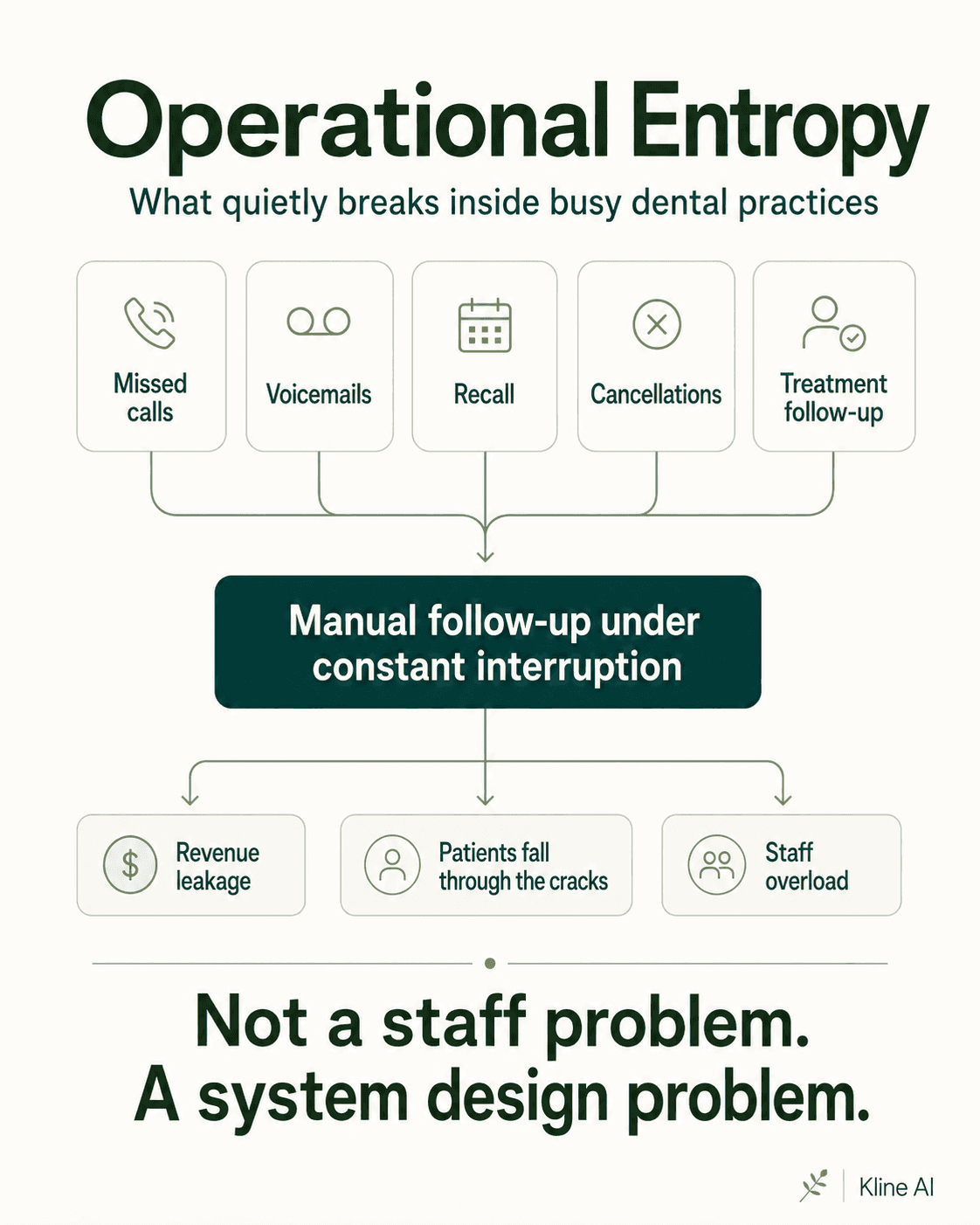
Operational entropy in a dental practice: missed calls, voicemails, recall, cancellations, and treatment follow-up feed manual follow-up under constant interruption, which leads to revenue leakage, patients falling through the cracks, and staff overload — not a staff problem, a system-design problem.

What it costs

Three things happen, all at once.

Revenue leaks

Each unclosed loop is a booking, a visit, or a treatment plan that quietly doesn't happen — and rarely shows up as a line item anyone notices.

Patients fall through the cracks

A patient who couldn't get through, or never heard back, doesn't complain. They just drift — and often end up at the practice down the street.

The team feels permanently behind

Not because anyone is doing a bad job, but because no human can hold hundreds of open loops in their head while the phones keep ringing.

The part most tools get wrong

This isn't a caring problem. It's not a motivation problem. And it's usually not even a hiring problem.

It's a system-design problem.

No matter how good your team is, they can't manually track and close every single patient loop while they're also answering phones, checking patients in, dealing with insurance, and keeping the schedule from falling apart. Asking them to is the bug — not the fix.

I believe the next generation of dental tools won't win by throwing more reminders, dashboards, or inboxes at the team. Every one of those is one more thing for a busy person to check.

They'll win by quietly making sure the important loops actually get closed — in the background, without anyone having to remember.

That's the shift we're building Kline around.

See it in numbers

Put a number on your practice's operational entropy.

The Revenue Recovery Calculator estimates what missed calls, no-shows, overdue recall, and unscheduled treatment may be costing your practice each year — with every assumption in the open. No signup to see your estimate.

FAQ

Operational entropy, in plain terms.

What is operational entropy in a dental practice?

Operational entropy is the steady accumulation of small, unclosed loops inside a busy practice — missed calls, unreturned voicemails, overdue hygiene recall, unfilled cancellations, and treatment plans that were presented but never scheduled. Each one seems minor in the moment, but together they leak revenue, let patients fall through the cracks, and leave the team feeling permanently behind.

Isn't this just a staffing problem?

Usually not. Even a fully staffed, motivated team can't manually track and close every patient loop while also answering phones, checking patients in, and handling insurance. The work depends on someone having time in the exact moment it's needed — and in a busy office, that moment often doesn't exist. It's a system-design problem, not a caring or hiring problem.

How do I measure operational entropy at my practice?

Start with the leak points: missed and after-hours calls, no-shows and last-minute cancellations, overdue hygiene recall, and recommended treatment that was never booked. Kline's free Revenue Recovery Calculator turns those into an estimated annual revenue range, with every assumption visible and editable.